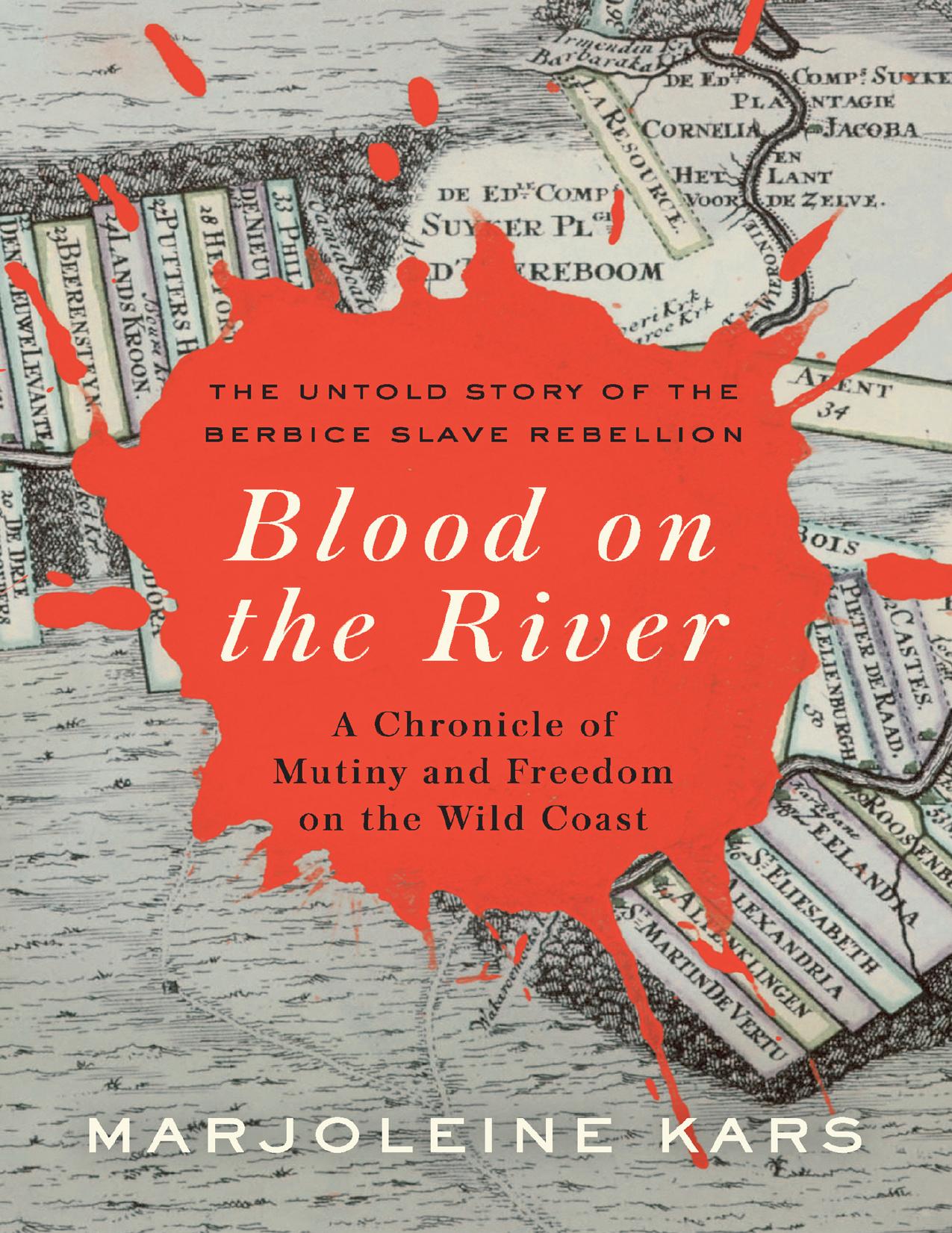
Blood on the River by Marjoleine Kars
Author:Marjoleine Kars
Language: eng
Format: epub, mobi, pdf
Publisher: The New Press
Published: 2020-08-15T00:00:00+00:00
11
The Battle for the Berbice
To Van Hoogenheim’s great relief, at long last two merchant ships, promised by the Company of Berbice six months before, arrived in late November with fifty new fighters. They were soon followed by the two naval ships authorized for emergency relief by the States General, adding 260 more soldiers. The two warships—Dolphijn, a three-masted frigate, and Zephyr, a two-masted snow—were small enough to navigate the Berbice. Still, the overloaded vessels needed a “spring tide,” the higher tide that followed a full moon, to clear sandbars in the river’s delta. Further delays were the result of a shortage of enslaved workers usually employed to unload incoming ships. In the absence of slaves, soldiers unaccustomed to the tropical heat struggled to unload the vessels and build their own shelters. Meanwhile, the men on Haringman’s ship, which had been in the colony for a month, were falling sick in ever greater numbers. As the hospital filled with feverish bodies and medicine ran low, Van Hoogenheim, regularly confined himself to his hammock with fevers and headaches, supplied the next best thing—red wine. Funerals once again became a daily occurrence.1
It took several weeks for the Europeans to prepare for their expedition up the Berbice River. One armed merchant ship remained anchored at Dageraad to provide protection; the second one anchored to the south near plantation Vigilantie to block rebels from fleeing downstream. Van Hoogenheim sent sixty soldiers to rendezvous with thirty mercenaries from British Barbados stationed in Demerara. The combined forces had orders to march from Demerara to the upper Berbice to form a wall to prevent rebels from disappearing into the hinterlands. Colonial soldiers posted on the Canje and the Corentyne Rivers were commanded to stop rebels from crossing into Suriname to join the Samaaka, or any other Maroon groups. Allied natives being armed in Essequibo and Suriname formed a second line of defense.2 With help from their neighbors and allies and with reinforcements from abroad, the Dutch set up a dragnet around the colony. Moreover, the rainy season was about to begin. It should have been an easy victory.
Download
Blood on the River by Marjoleine Kars.mobi
Blood on the River by Marjoleine Kars.pdf
This site does not store any files on its server. We only index and link to content provided by other sites. Please contact the content providers to delete copyright contents if any and email us, we'll remove relevant links or contents immediately.
| Africa | Americas |
| Arctic & Antarctica | Asia |
| Australia & Oceania | Europe |
| Middle East | Russia |
| United States | World |
| Ancient Civilizations | Military |
| Historical Study & Educational Resources |
The Dawn of Everything by David Graeber & David Wengrow(1707)
The Bomber Mafia by Malcolm Gladwell(1622)
Facing the Mountain by Daniel James Brown(1553)
Submerged Prehistory by Benjamin Jonathan; & Clive Bonsall & Catriona Pickard & Anders Fischer(1455)
Wandering in Strange Lands by Morgan Jerkins(1426)
Tip Top by Bill James(1414)
Driving While Brown: Sheriff Joe Arpaio Versus the Latino Resistance by Terry Greene Sterling & Jude Joffe-Block(1375)
Red Roulette : An Insider's Story of Wealth, Power, Corruption, and Vengeance in Today's China (9781982156176) by Shum Desmond(1359)
Evil Geniuses: The Unmaking of America: A Recent History by Kurt Andersen(1352)
The Way of Fire and Ice: The Living Tradition of Norse Paganism by Ryan Smith(1336)
American Kompromat by Craig Unger(1315)
F*cking History by The Captain(1302)
It Was All a Lie by Stuart Stevens;(1300)
American Dreams by Unknown(1285)
Treasure Islands: Tax Havens and the Men who Stole the World by Nicholas Shaxson(1272)
Evil Geniuses by Kurt Andersen(1257)
White House Inc. by Dan Alexander(1211)
The First Conspiracy by Brad Meltzer & Josh Mensch(1173)
The Fifteen Biggest Lies about the Economy: And Everything Else the Right Doesn't Want You to Know about Taxes, Jobs, and Corporate America by Joshua Holland(1125)
